

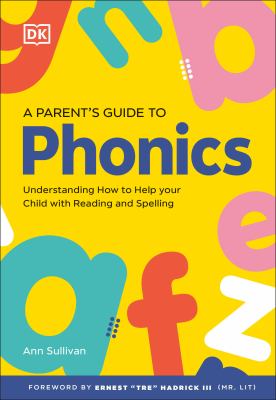
Introduction by Librarian
All parents wish to have their children intelligently trained so that they can pursue a better life when they grow up. To gear up children for the competitive world, Hong Kong parents often tend to pack their children’s schedule with a list of extra-curricular activities lest they should lose at the beginning. One of the most popular skills is communication, which is founded on language competence, and when it comes to language learning, phonics skills is surely highlighted.
Language acquisition requires an environment with sufficient support and input for the learners. But “how” can it be accomplished? This recommended book “A parent's guide to phonics: understanding how to help your child with reading and spelling” may help. This book is concisely written and divided into 18 bite-size sections targeting busy parents, and it offers useful tips to teach parents how to guide young learners to acquire phonics at home. The activities suggested require minimum effort, such as letter-sound matching and rhyming games. Once your children have mastered the forms and sounds, they will be ready to move on to another milestone.
Parents of children with special educational needs may even find it harder to take up the teaching role at home, so this book offers you a time-economical efficient option. Apart from the general activities introduced, the author also includes a small proportion on teaching children who need extra care and assistance. To provide additional support to parents, this book also takes you into a deep dive into how phonics helps cultivate a habitual young reader, and enables them to become a confident writer who can freely express thoughts and ideas with their accumulation of new vocabulary through extensive reading activities.
On the learning journey, challenges are sometimes inevitable, and if you find yourselves stuck at the bottleneck without much progress, this book could again give you some clues to overcome the challenges. One of the most common mistakes parents may make is to mix up “reading to children” and “reading with children”. Without active engagement, no skill can be developed as expected.
All in all, phonics is indeed a taught skill, yet this mission is achievable at home where children feel the most secure. I hope this book offers parents a flexible alternative to integrate phonics learning activities into the quality family time, and please remember every child is unique, who has their own learning pace, styles and preferences. You can always modify the activities to suit your needs, and it is vital to stay open-minded, and do not hesitate to consult professionals if needed.